
Ship with confidence.
RefactIQ helps you understand what’s risky, why it matters, and what to fix next so you can keep shipping with confidence instead of hope.
“This thing understands my app.”
Before you see findings, RefactIQ generates an App Insight summary — a fast, readable explanation of what your app does and how it’s put together. You’ll see it “get” your app before it critiques it.
Architecture snapshot
A clean overview of the major components, boundaries, and coupling — so the shape of the codebase becomes clear fast.
Risk map
The audit prioritizes what’s likely to break or bleed time — the stuff that blocks launches.
Ready-to-fix findings
Findings are written for action: what’s happening, why it matters, and what to do next.
It’s like having a senior dev helping you catch what could break before users do.
Open. Decide. Move on.
RefactIQ is built for shipping. You’re not here to debate lint rules. You’re here to keep improving the app, reduce unknown risk, and stay moving.
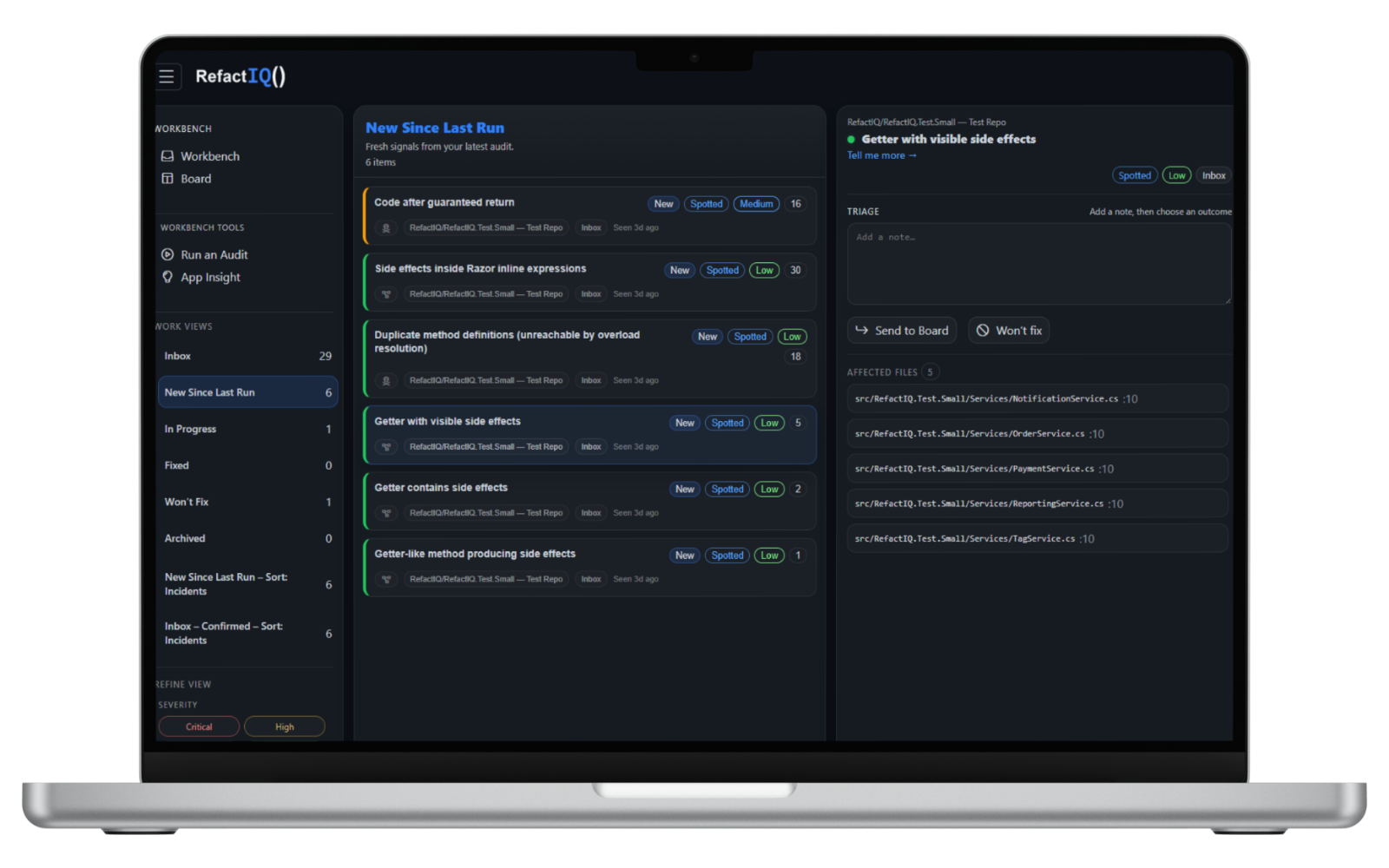
Run an audit and see a clean, triage-ready queue grouped by severity and impact.
When a finding is unclear, open “Tell me more” for deeper explanation tailored to your experience level, plus examples you can use, so you can make the call fast.
Make the call, capture the next step, and keep momentum without losing the plot.
A simple fix flow when you need it.
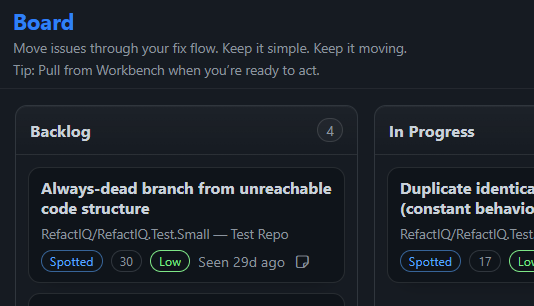
Workbench is where you decide. The Board is where you move fixes forward. A clean flow that keeps work moving without turning your life into Jira.
The stuff that slips through.
RefactIQ is tuned for real-world failure modes, so you get findings you can actually ship on.
A few quick answers.
The short version, without the marketing fog.
What languages and stacks does RefactIQ support?
How is this different from a linter or static analyzer?
Traditional tools flag syntax patterns and style violations. RefactIQ analyzes structure, architecture, and failure patterns across your codebase — the kinds of issues that usually surface only during painful code reviews or production incidents.
Is this like CodeRabbit or PR-based AI code review?
Tools like CodeRabbit review pull requests — analyzing diffs and commenting inline during code review. RefactIQ looks at the health of your entire codebase instead.
RefactIQ analyzes the architecture of your codebase — not just the latest diff.
Rather than reviewing a single PR, it audits structure, architecture, and reliability patterns across the project and sends findings to your Workbench for triage. Think of it less like a PR reviewer and more like an architectural safety check for your codebase.What will I actually get from an audit?
Instead of dumping a wall of output on you, RefactIQ helps you review, prioritize, and improve your codebase over time — so you can keep shipping without losing momentum.
How do I send you my code?
Once connected, RefactIQ pulls the code it needs for analysis, processes the audit, and deletes the source copy before the process is finished.
What do you do with my code after the audit?
What remains in your account is your audit output inside RefactIQ — findings in your Workbench, triage status, and audit history — not your source code.
How much does RefactIQ cost?
One simple plan. No confusing tiers. No per-seat nonsense.
Can I try it without signing up?
It’s our way of proving value before asking for commitment.
How accurate are the findings?
Findings are structured, traceable to code locations, and designed to help you make decisions quickly — not bury you in theory.

Built by a dev who’s seen how apps die at 80%.
Great apps usually don’t die because the idea was bad. They die because the codebase hides too many unknowns. RefactIQ exists to help builders see risk clearly, make better calls faster, and turn “I hope this holds” into “I know what to fix next.”
Want in when it opens?
Join the early list. You’ll get the launch email, and that’s basically it.